
Share:👇
Introduction
In the fast-paced and highly competitive world of digital marketing, standing out in the inbox is crucial for the success of any business. One of the most effective strategies to improve the performance of your email campaigns is A/B testing. By systematically testing different elements of your emails, you can gain valuable insights into what resonates best with your audience and make data-driven decisions to optimize your email marketing efforts.
In this comprehensive guide, we’ll dive deep into the world of A/B testing for email marketing, exploring its benefits, the key elements to test, and the step-by-step process to conduct effective A/B tests. Whether you’re a seasoned email marketer or just starting out, this guide will equip you with the knowledge and tools you need to take your email campaigns to new heights.
The Importance of A/B Testing in Email Marketing
Email marketing remains one of the most powerful and cost-effective digital marketing strategies, with an average return on investment of $36 for every $1 spent. However, in an increasingly crowded inbox, it’s crucial to make your emails stand out and engage your subscribers.
That’s where A/B testing comes into play. By systematically testing different elements of your email campaigns, you can:
- Improve Open Rates: Test subject lines, preview text, and sender names to determine what compels your subscribers to open your emails.
- Boost Click-Through Rates: Experiment with call-to-action buttons, email copy, and content layout to optimize for higher engagement.
- Increase Conversions: Refine your email offers, landing pages, and overall user experience to drive more subscribers to take the desired action.
- Enhance Customer Experience: Use A/B testing to better understand your audience’s preferences and tailor your email content and design to their needs.
- Optimize for Email Deliverability: Test factors that impact email deliverability, such as sender reputation and spam-filtering triggers, to ensure your messages reach the inbox.
By continuously testing and improving your email campaigns, you can maximize the return on your email marketing investment and stay ahead of the competition.
Key Elements to A/B Test in Email Marketing
When it comes to A/B testing in email marketing, there are a wide range of elements you can experiment with. Here are some of the most impactful areas to consider:
Subject Lines
The subject line is often the first and most important element that determines whether your email will be opened. A/B testing your subject lines can provide valuable insights into what resonates with your audience.
Some elements to test include:
- Length
- Tone (e.g., conversational, formal, playful)
- Personalization (e.g., including the recipient’s name)
- Emojis
- Urgency or scarcity cues
- Curiosity-inducing language
For example, you could test the subject lines “20% Off Your Next Purchase” vs. “Don’t Miss Out on Our Latest Offer” to see which one performs better.
Preview Text
The preview text, also known as preheader text, is the snippet of text that appears next to or below the subject line in the recipient’s inbox. It’s another crucial element that can influence open rates.
Some aspects to experiment with include:
- Length
- Relevance to the email content
- Complementary messaging to the subject line
- Calls-to-action
You could test “Claim your 20% discount now” vs. “Shop our latest collection” to see which preview text compels more subscribers to open your email.
Sender Name and Email Address
The sender name and email address can also impact open rates, as they contribute to the overall trustworthiness and familiarity of your brand in the recipient’s inbox.
Test variations such as:
- Using a personal name vs. a brand name
- Incorporating the company name vs. omitting it
- Leveraging a dedicated email address vs. a generic one (e.g., support@company.com vs. john@company.com)
Email Content and Layout
The content and layout of your email can significantly influence click-through and conversion rates. Some elements to experiment with include:
- Call-to-action (CTA) buttons: Test the placement, size, color, and wording of your CTA buttons.
- Email Copy: Experiment with different tones, writing styles, and messaging to see what resonates best.
- Visual Elements: Test the impact of images, videos, GIFs, and other visual content on engagement.
- Layout and Structure: Explore different email templates, column arrangements, and the placement of key elements.
By testing these elements, you can optimize your email content to better align with your audience’s preferences and drive higher conversions.
Offers and Incentives
The offers and incentives you include in your emails can significantly impact click-through and conversion rates. Some ideas to test include:
- Discounts and Promo Codes: Test different discount percentages, dollar amounts, or promo code formats.
- Free Shipping: Experiment with offering free shipping vs. not offering it.
- Exclusive Content or Product Access: Test the impact of offering exclusive content, early access, or other VIP-style incentives.
By evaluating the performance of different offers and incentives, you can find the most effective way to incentivize your subscribers to take action.
Send Timing and Frequency
The timing and frequency of your email campaigns can also have a significant impact on their performance. Some factors to consider testing include:
- Send Time: Experiment with sending emails at different times of day or days of the week to determine the optimal send time for your audience.
- Send Frequency: Test the impact of sending emails daily, weekly, or monthly to find the sweet spot that keeps your subscribers engaged without overwhelming them.
- Cadence of Nurture Campaigns: Experiment with the timing and frequency of your lead nurturing email sequences.
By optimizing your send timing and frequency, you can ensure your emails reach your subscribers at the right moments and keep them engaged with your brand.
The A/B Testing Process
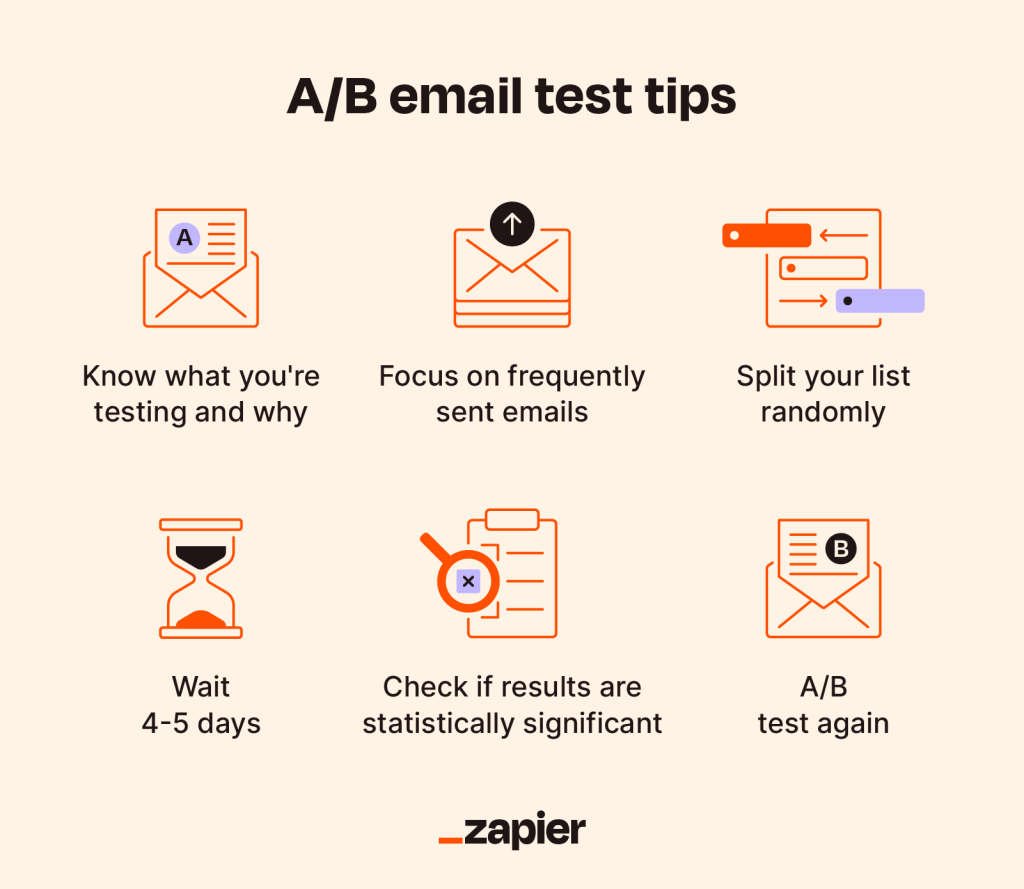
Conducting effective A/B tests for your email marketing campaigns involves a methodical, step-by-step approach. Here’s a general outline of the process:
- Define Your Goals: Clearly articulate the specific objectives you want to achieve with your A/B test, such as improving open rates, increasing click-through rates, or boosting conversions.
- Identify the Elements to Test: Based on your goals, determine which email elements you want to test, such as subject lines, preview text, content, or offers.
- Create Your Test Variations: Develop two or more variations of the element you want to test. For example, if testing subject lines, create two different subject line options.
- Determine Your Sample Size and Target Audience: Decide on the size of your test audience and ensure that it’s large enough to provide statistically significant results. You may also want to target specific segments of your subscriber base.
- Implement the A/B Test: Send the different variations of your email to your test audience, ensuring that you have a fair and random distribution of the test groups.
- Monitor and Analyze the Results: Closely track the performance of your email variations, comparing metrics such as open rates, click-through rates, and conversions. Use statistical analysis to determine the statistical significance of the results.
- Implement the Winning Variation: Once you’ve identified the winning variation, implement it in your future email campaigns to optimize their performance.
- Iterate and Continuously Test: Don’t stop at just one A/B test. Continue to experiment with new elements and build on your learnings to further refine and improve your email marketing strategy.
By following this process, you can ensure that your A/B tests are well-designed, provide meaningful insights, and ultimately help you achieve your email marketing goals.
Best Practices for Effective A/B Testing
To get the most out of your A/B testing efforts, consider the following best practices:
- Start with a Clear Hypothesis: Before launching your test, have a clear hypothesis about which variation you expect to perform better and why. This will help you interpret the results more effectively.
- Test One Element at a Time: To ensure the validity of your results, focus on testing a single element at a time. Avoid making multiple changes within the same test, as it will be difficult to attribute the results to a specific factor.
- Use Statistically Significant Sample Sizes: Make sure your test groups are large enough to produce statistically significant results. Use a tool like Optimizely’s Sample Size Calculator to determine the appropriate sample size.
- Randomize Your Test Groups: Ensure that your test groups are randomly distributed to avoid any potential biases in your results.
- Set a Clear Timeframe: Establish a specific timeframe for your A/B test, allowing enough time to gather sufficient data while avoiding skewed results due to external factors.
- Analyze the Entire Customer Journey: Don’t just focus on the immediate email metrics, such as open and click-through rates. Also, consider the impact on downstream metrics like conversions and revenue.
- Document Your Findings: Carefully document your test setup, results, and learnings. This will help you build a knowledge base and make more informed decisions in future A/B tests.
- Automate Your A/B Testing Process: Leverage email marketing tools and platforms that offer built-in A/B testing capabilities to streamline the process and make it easier to scale your testing efforts.
- Communicate and Collaborate: Share your A/B testing insights and learnings with cross-functional teams, such as marketing, product, and design, to drive more holistic optimization efforts.
- Continuously Iterate and Improve: Don’t treat A/B testing as a one-time activity. Embrace it as an ongoing process to continuously refine and improve your email marketing strategies.
By following these best practices, you can ensure that your A/B testing efforts are systematic, data-driven, and yield meaningful insights to optimize your email marketing performance.
A/B Testing Tools and Resources
To support your A/B testing efforts, there are various tools and resources available:
A/B Testing Tools
- Mailchimp – Mailchimp’s built-in A/B testing capabilities allow you to test subject lines, content, send time, and more.
- Constant Contact – Constant Contact provides A/B testing for subject lines, content, and send time.
- Optimizely – Optimizely is a leading A/B testing and experimentation platform for web and mobile.
- Google Optimize – Google’s free A/B testing and personalization tool that integrates with Google Analytics.
- VWO – VWO offers A/B testing, split testing, and optimization solutions for websites and mobile apps.
Email Marketing Resources
- HubSpot’s Email Marketing Resource Library – Comprehensive guides, templates, and best practices for effective email marketing.
- Litmus Email Analytics – Litmus provides detailed email analytics and insights to optimize your campaigns.
- Campaign Monitor’s Email Marketing Academy – Educational resources and tutorials on various email marketing topics.
- Sendgrid Email Marketing Blog – Helpful articles and insights from the Sendgrid team.
- Mailchimp Email Marketing Tips – Mailchimp’s collection of email marketing best practices and strategies.
A/B Testing Guides and Tutorials
- Optimizely’s A/B Testing Beginner’s Guide
- Hubspot’s Guide to A/B Testing in Email Marketing
- Mailchimp’s Guide to A/B Testing Email Campaigns
- Constant Contact’s A/B Testing Best Practices
- Litmus’ A/B Testing for Email: The Complete Guide
By leveraging these tools and resources, you can streamline your A/B testing efforts, gain deeper insights, and continuously optimize your email marketing campaigns for better performance.
Conclusion
A/B testing is a powerful and indispensable tool in the email marketer’s arsenal. By systematically testing different elements of your email campaigns, you can gain valuable insights into your audience’s preferences, optimize your email content and design, and ultimately drive better results for your business.
Remember, effective A/B testing is an ongoing process, not a one-time activity. Embrace it as a key part of your email marketing strategy and continuously iterate and improve your campaigns based on the insights you uncover.
With the right approach, tools, and resources, you can unlock the full potential of A/B testing and take your email marketing to new heights. So, what are you waiting for? Start testing and watch your email performance soar!
Share:👇
Subscribe to get more of such amazing content 👇
Related post
- How to Start a Print on Demand Business: A Comprehensive Guide
 Share:👇 Starting a print on demand (POD) business can be an exciting and profitable venture, especially in today’s era of e-commerce. Whether you’re an artist looking to monetize your designs or an entrepreneur exploring new business avenues, the POD model offers a low-risk, scalable method of selling custom products without the need for inventory or… Read more: How to Start a Print on Demand Business: A Comprehensive Guide
 - Mistakes Most Young Entrepreneurs Make When Starting an Online Business
 Share:👇 Starting an online business can be an exciting and rewarding venture for young entrepreneurs, but it also comes with its fair share of challenges. Many young entrepreneurs make common mistakes that can hinder their success and lead to the downfall of their businesses. In this comprehensive guide, we will explore the most prevalent mistakes… Read more: Mistakes Most Young Entrepreneurs Make When Starting an Online Business
 - Starting a Dropshipping Website on Spocket: What You Need to Know
 Share:👇 Introduction In the ever-evolving world of e-commerce, dropshipping has emerged as a game-changing business model that has revolutionized the way entrepreneurs approach online retail. Spocket, a leading dropshipping platform, has become a popular choice for those looking to venture into this lucrative space. [1] This comprehensive guide will delve into the intricacies of starting… Read more: Starting a Dropshipping Website on Spocket: What You Need to Know
 - The 10 Best Dropshipping Websites for Ecommerce Success in 2024
 Share:👇 Introduction In the ever-evolving world of ecommerce, dropshipping has emerged as a game-changing business model that allows entrepreneurs to start and scale online stores without the hassle of managing inventory. By partnering with reliable suppliers, dropshipping enables you to offer a wide range of products to your customers while minimizing upfront costs and overhead.… Read more: The 10 Best Dropshipping Websites for Ecommerce Success in 2024
 - The Ultimate Guide to the Best Affiliate Marketing Websites
 Share:👇 Introduction Affiliate marketing has become one of the most popular ways to earn passive income online. With the right strategies and tools, you can turn your website into a revenue-generating machine. In this guide, we’ll explore the best affiliate marketing websites, provide in-depth reviews, and share tips on how to maximize your earnings. What… Read more: The Ultimate Guide to the Best Affiliate Marketing Websites
 - Mastering Long-Form Content for SEO in 2024 and Beyond
 Share:👇 In the ever-evolving world of search engine optimization (SEO), the importance of long-form content has become increasingly apparent. As Google and other search engines continue to prioritize high-quality, in-depth information, crafting compelling long-form content has become a crucial strategy for businesses and content creators looking to rank higher in search results and engage their… Read more: Mastering Long-Form Content for SEO in 2024 and Beyond
 - The Rise of AI in SEO: Navigating the Changing Landscape of Search Engine Optimization in 2024 and Beyond
 Share:👇 Introduction: The Evolving Role of AI in SEO As we look ahead to 2024 and beyond, the world of search engine optimization (SEO) is undergoing a profound transformation, driven largely by the rapid advancements in artificial intelligence (AI) technology. The impact of AI on SEO is undeniable, presenting both opportunities and challenges for marketers,… Read more: The Rise of AI in SEO: Navigating the Changing Landscape of Search Engine Optimization in 2024 and Beyond
 - The Transformative Role of Blockchain in Digital Marketing
 Share:👇 Introduction In the ever-evolving landscape of digital marketing, the emergence of blockchain technology has sparked a revolution, redefining the way businesses engage with their customers and approach their marketing strategies. As the digital world continues to grapple with issues of transparency, data security, and trust, blockchain has emerged as a game-changing solution, offering a… Read more: The Transformative Role of Blockchain in Digital Marketing
 - Unlocking the Power of Facebook Ads: A Comprehensive Guide to Maximizing ROI
 Share:👇 In the ever-evolving digital landscape, Facebook ads have emerged as a powerful tool for businesses of all sizes to reach and engage their target audience. With over 2.9 billion monthly active users, Facebook provides unparalleled access to a vast and diverse customer base, making it an essential component of any comprehensive marketing strategy. However,… Read more: Unlocking the Power of Facebook Ads: A Comprehensive Guide to Maximizing ROI
 - The Future of Affiliate Marketing: Navigating the Evolving Landscape
 Share:👇 Introduction: The Affiliate Marketing Landscape in Flux In the ever-changing world of digital marketing, affiliate marketing has emerged as a powerful and lucrative strategy for businesses and individuals alike. As the industry continues to evolve, it’s crucial for both seasoned and aspiring affiliate marketers to stay ahead of the curve and understand the trends… Read more: The Future of Affiliate Marketing: Navigating the Evolving Landscape



 Hubgenus