
Share:👇
Discover how to use Optimizely’s powerful sample size calculator to ensure your A/B tests have the statistical power to deliver meaningful insights. Learn expert tips and best practices for calculating the right sample size for your experiments.
: Introduction to Optimizely’s Sample Size Calculator
In the fast-paced world of digital marketing, A/B testing has become an essential tool for data-driven organizations looking to optimize their websites, campaigns, and customer experiences. At the heart of any successful A/B testing program lies a critical component: the sample size calculator.
Optimizely, a leading experimentation platform, offers a robust sample size calculator that helps marketers, product managers, and data analysts determine the appropriate number of users to include in their experiments. This calculator is a valuable resource for ensuring the statistical validity of your tests and maximizing the impact of your optimization efforts.
In this comprehensive guide, we’ll dive deep into Optimizely’s sample size calculator, exploring its key features, best practices for usage, and how it can be leveraged to drive impactful results for your business.
Header 2: Understanding the Importance of Sample Size
Before we delve into the mechanics of Optimizely’s sample size calculator, it’s essential to understand the importance of sample size in the context of A/B testing.
The sample size, which represents the number of users or visitors exposed to each variation of an experiment, is a critical factor in determining the statistical significance and reliability of your test results. A sample size that is too small can lead to inconclusive or unreliable findings, while a sample size that is too large can result in wasted resources and missed opportunities.
Accurately calculating the required sample size is crucial for several reasons:
- Statistical Significance: A large enough sample size ensures that any observed differences between the test variations are statistically significant, meaning they are unlikely to have occurred by chance.
- Detecting Meaningful Differences: A well-calculated sample size increases the likelihood of detecting meaningful, practical differences between the test variations, allowing you to make informed decisions about which option to implement.
- Experiment Duration: Determining the appropriate sample size can help optimize the duration of your experiments, ensuring you collect enough data to draw reliable conclusions without unnecessarily extending the test period.
- Resource Allocation: Proper sample size calculation helps you allocate your resources (e.g., website traffic, marketing budget) efficiently, avoiding the waste of valuable time and money on inconclusive tests.
By understanding the importance of sample size, you can leverage Optimizely’s sample size calculator to design and execute A/B tests that deliver actionable insights and drive measurable improvements to your business.
Header 2: Exploring Optimizely’s Sample Size Calculator
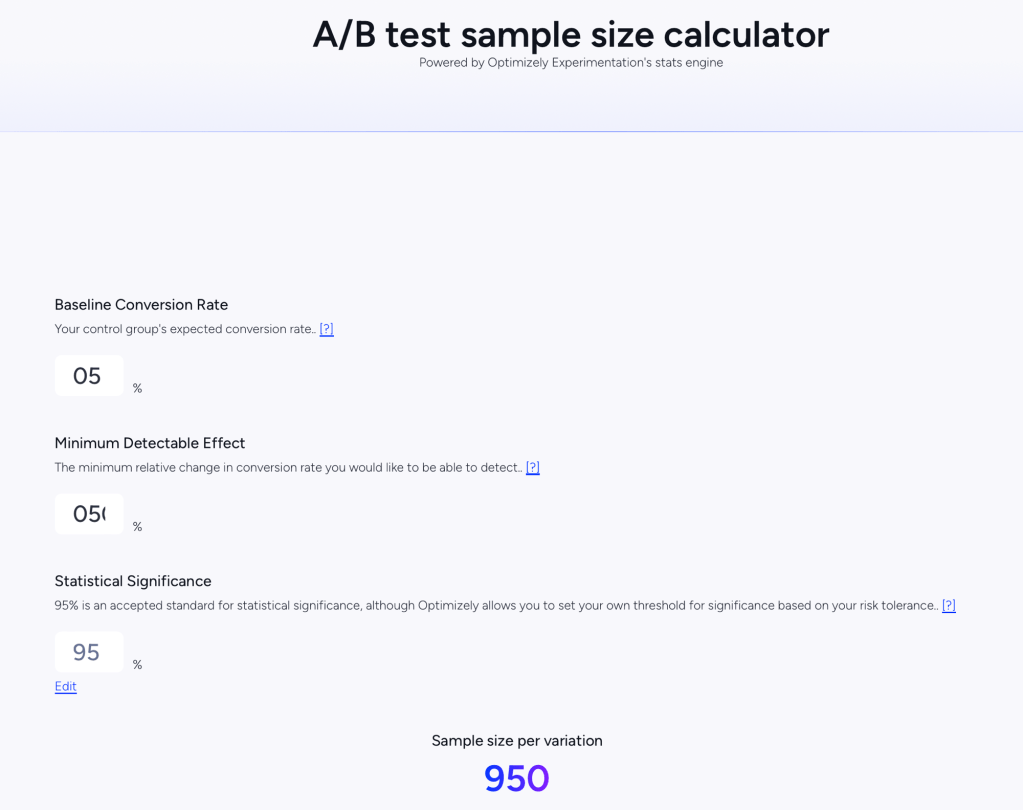
Optimizely’s sample size calculator is a powerful tool that helps you determine the appropriate number of users to include in your A/B tests. Let’s dive into the key features and functionality of this calculator:
1. Minimum Detectable Effect (MDE):
The Minimum Detectable Effect (MDE) is the smallest difference in the metric you want to measure that you consider meaningful. This could be, for example, a 5% increase in conversion rate or a 10% decrease in bounce rate. The MDE is a crucial input for the sample size calculation, as it directly influences the required number of participants.
2. Significance Level (α):
The significance level, also known as the alpha (α) value, represents the acceptable probability of making a Type I error, or falsely detecting a difference when there is none. Optimizely’s sample size calculator typically uses a standard significance level of 5% (α = 0.05), which is a commonly accepted threshold in the industry.
3. Statistical Power (1-β):
Statistical power is the likelihood of detecting an effect if it truly exists. It is the complement of the Type II error rate (β), which is the probability of failing to detect a difference when there is one. Optimizely’s calculator generally recommends a statistical power of 80% (1-β = 0.8), a widely accepted standard in A/B testing.
4. Baseline Conversion Rate:
The baseline conversion rate is the expected conversion rate for the control or original variation of your experiment. This metric is essential for calculating the sample size, as it directly impacts the number of users required to detect a meaningful difference.
5. Desired Lift:
The desired lift, also known as the Minimum Detectable Effect (MDE), is the smallest difference in the metric you want to measure that you consider meaningful. This could be, for example, a 5% increase in conversion rate or a 10% decrease in bounce rate.
6. Traffic Allocation:
The traffic allocation setting in Optimizely’s sample size calculator allows you to specify the percentage of users that will be exposed to each variation of your experiment. The default setting is an even 50/50 split, but you can adjust this based on your testing strategy.
By inputting these key parameters, Optimizely’s sample size calculator will provide you with the recommended minimum sample size for your A/B test, ensuring you have the statistical power to detect meaningful differences and make data-driven decisions.
: Best Practices for Using Optimizely’s Sample Size Calculator
To get the most out of Optimizely’s sample size calculator and ensure the validity of your A/B testing efforts, consider the following best practices:
- Understand Your Business Objectives: Before calculating the sample size, it’s crucial to clearly define your business objectives and the metric(s) you want to optimize. This will help you determine the appropriate Minimum Detectable Effect (MDE) and ensure your test is aligned with your strategic goals.
- Leverage Historical Data: If you have access to historical data from previous A/B tests or website performance, use that information to inform your baseline conversion rate and expected lift. This will help you generate more accurate sample size estimates.
- Account for Potential Variability: Keep in mind that user behavior and conversion rates can fluctuate, especially in the initial stages of an experiment. Consider adding a buffer to your sample size calculation to account for potential variability and ensure your test has enough statistical power.
- Monitor and Adjust as Needed: Regularly monitor the progress of your A/B test and be prepared to adjust the sample size if necessary. If you notice significant deviations from your initial assumptions, you may need to recalculate the sample size to maintain the validity of your findings.
- Consult with Statisticians or Experts: If you’re unsure about any of the inputs or assumptions required for the sample size calculation, consider consulting with a statistician or a team member with expertise in A/B testing and experimental design. Their guidance can help you avoid common pitfalls and ensure the integrity of your tests.
- Segment Your Audience: When possible, consider segmenting your audience and running separate tests for different user groups. This can provide more granular insights and help you identify the most impactful optimization opportunities.
- Ensure Consistent Data Collection: Implement robust data collection processes to ensure the accuracy and reliability of the metrics you’re using in your sample size calculations. Any discrepancies or inconsistencies in data can skew your results.
By following these best practices, you can leverage Optimizely’s sample size calculator to design and execute A/B tests that deliver meaningful, statistically significant insights to drive your business forward.
Header 2: Leveraging Optimizely’s Sample Size Calculator: Case Studies and Examples
To illustrate the practical application of Optimizely’s sample size calculator, let’s explore a few real-world case studies and examples:
Case Study 1: Optimizing the Call-to-Action Button on an E-commerce Website
A leading e-commerce brand wanted to increase its conversion rate on the product page. They hypothesized that changing the call-to-action (CTA) button’s color and copy might improve user engagement and lead to more purchases.
Using Optimizely’s sample size calculator, the team determined that they would need a minimum of 10,000 visitors (5,000 per variation) to detect a 10% increase in conversion rate, with a 95% confidence level and 80% statistical power.
By running the A/B test and leveraging the insights from the sample size calculation, the team was able to identify a new CTA design that drove a 12% increase in conversion rate, resulting in a significant boost in revenue.
Example 2: Optimizing Email Marketing Campaigns
A SaaS company wanted to improve the open rates and click-through rates of its email marketing campaigns. They decided to test different subject line variations and email copy to determine the most effective approach.
The team used Optimizely’s sample size calculator to determine that they would need a minimum of 15,000 email recipients (7,500 per variation) to detect a 15% improvement in open rate, with a 95% confidence level and 80% statistical power.
The A/B test revealed that a revised subject line and email copy increased the open rate by 18% and the click-through rate by 22%, allowing the company to optimize its email marketing strategy and drive more leads and conversions.
Case Study 3: Improving the Layout and Structure of a B2B Website
A B2B software company wanted to optimize the layout and structure of its website to enhance user engagement and lead generation. They hypothesized that reorganizing the content and navigation could improve the time users spent on the site and increase the number of form submissions.
Using Optimizely’s sample size calculator, the team determined that they would need a minimum of 12,000 website visitors (6,000 per variation) to detect a 12% increase in time on site, with a 95% confidence level and 80% statistical power.
The A/B test results showed that the new website layout and structure led to a 15% increase in time on site and a 17% rise in form submissions, enabling the company to optimize the user experience and drive more qualified leads.
These case studies demonstrate how Optimizely’s sample size calculator can be leveraged to design and execute impactful A/B tests across various digital marketing channels, from e-commerce websites to email campaigns and B2B web experiences.
Header 2: Linking Optimizely’s Sample Size Calculator to Other Digital Marketing Strategies
While the focus of this guide has been on the use of Optimizely’s sample size calculator in the context of A/B testing, it’s important to recognize the broader applications and synergies this tool can have with other digital marketing strategies. Let’s explore some of the connections and how you can leverage the sample size calculator to drive even greater impact:

1. Email Marketing:
The sample size calculator can be a valuable tool when optimizing email marketing campaigns. By determining the appropriate number of recipients for A/B tests on subject lines, email copy, and call-to-action buttons, you can ensure your experiments have the statistical power to deliver meaningful insights and drive higher open rates, click-through rates, and conversions.
2. Call-to-Action Buttons:
As demonstrated in the case study, the sample size calculator can be instrumental in optimizing call-to-action buttons on your website or landing pages. By testing different button designs, copy, and placements, you can identify the most effective CTA elements to boost user engagement and conversions.
3. Email Copy:
Similar to the email marketing example, the sample size calculator can help you determine the right number of recipients to test different email copy variations, such as tone, personalization, and value propositions, to improve the overall effectiveness of your email campaigns.
4. Visual Elements:
The sample size calculator can also be applied to experiments involving visual elements on your website or marketing materials, such as images, graphics, and videos. By testing different visual treatments, you can optimize the user experience and drive higher engagement.
5. Layout and Structure:
As seen in the B2B website case study, the sample size calculator can be used to test variations in the layout and structure of your website or digital assets, ensuring you have the statistical power to detect meaningful improvements in user behavior and conversion rates.
6. Discount and Promo Codes:
The sample size calculator can be leveraged when testing the impact of different discount and promo code offerings on user behavior and conversion rates. By determining the appropriate sample size, you can identify the most effective promotional strategies to drive sales and revenue.
7. Free Shipping:
Similarly, the sample size calculator can be used to test the impact of free shipping offers on purchase behavior, helping you optimize your shipping policies and drive higher conversion rates.
8. Exclusive Content or Promo Access:
When testing the effectiveness of exclusive content or promotional access, the sample size calculator can help you determine the right number of users to include in your experiments, ensuring you gather reliable data to inform your content and access strategies.
By connecting Optimizely’s sample size calculator to these other digital marketing strategies, you can enhance the impact of your A/B testing efforts and drive more comprehensive, data-driven optimizations across your marketing initiatives.
Conclusion
In the dynamic world of digital marketing, the ability to make data-driven decisions is paramount. Optimizely’s sample size calculator is a powerful tool that empowers marketers, product managers, and data analysts to design and execute A/B tests with confidence, ensuring the statistical validity of their findings and the effectiveness of their optimization efforts.
By mastering the use of Optimizely’s sample size calculator, you can:
- Determine the appropriate number of users to include in your A/B tests, balancing statistical significance with resource efficiency.
- Detect meaningful differences between test variations, allowing you to make informed decisions that drive tangible business outcomes.
- Optimize the duration of your experiments, maximizing the impact of your testing program.
- Leverage the sample size calculator across a variety of digital marketing strategies, from email campaigns to website optimization and beyond.
As you continue to refine your A/B testing practices and explore new ways to optimize your digital assets, remember the importance of the sample size calculator. By incorporating this powerful tool into your workflow, you can unlock the full potential of your experimentation program and propel your business towards greater success.
Share:👇
Subscribe to get more of such amazing content 👇
Related post
- How to Start a Print on Demand Business: A Comprehensive Guide
 Share:👇 Starting a print on demand (POD) business can be an exciting and profitable venture, especially in today’s era of e-commerce. Whether you’re an artist looking to monetize your designs or an entrepreneur exploring new business avenues, the POD model offers a low-risk, scalable method of selling custom products without the need for inventory or… Read more: How to Start a Print on Demand Business: A Comprehensive Guide
 - Mistakes Most Young Entrepreneurs Make When Starting an Online Business
 Share:👇 Starting an online business can be an exciting and rewarding venture for young entrepreneurs, but it also comes with its fair share of challenges. Many young entrepreneurs make common mistakes that can hinder their success and lead to the downfall of their businesses. In this comprehensive guide, we will explore the most prevalent mistakes… Read more: Mistakes Most Young Entrepreneurs Make When Starting an Online Business
 - Starting a Dropshipping Website on Spocket: What You Need to Know
 Share:👇 Introduction In the ever-evolving world of e-commerce, dropshipping has emerged as a game-changing business model that has revolutionized the way entrepreneurs approach online retail. Spocket, a leading dropshipping platform, has become a popular choice for those looking to venture into this lucrative space. [1] This comprehensive guide will delve into the intricacies of starting… Read more: Starting a Dropshipping Website on Spocket: What You Need to Know
 - The 10 Best Dropshipping Websites for Ecommerce Success in 2024
 Share:👇 Introduction In the ever-evolving world of ecommerce, dropshipping has emerged as a game-changing business model that allows entrepreneurs to start and scale online stores without the hassle of managing inventory. By partnering with reliable suppliers, dropshipping enables you to offer a wide range of products to your customers while minimizing upfront costs and overhead.… Read more: The 10 Best Dropshipping Websites for Ecommerce Success in 2024
 - The Ultimate Guide to the Best Affiliate Marketing Websites
 Share:👇 Introduction Affiliate marketing has become one of the most popular ways to earn passive income online. With the right strategies and tools, you can turn your website into a revenue-generating machine. In this guide, we’ll explore the best affiliate marketing websites, provide in-depth reviews, and share tips on how to maximize your earnings. What… Read more: The Ultimate Guide to the Best Affiliate Marketing Websites
 - Mastering Long-Form Content for SEO in 2024 and Beyond
 Share:👇 In the ever-evolving world of search engine optimization (SEO), the importance of long-form content has become increasingly apparent. As Google and other search engines continue to prioritize high-quality, in-depth information, crafting compelling long-form content has become a crucial strategy for businesses and content creators looking to rank higher in search results and engage their… Read more: Mastering Long-Form Content for SEO in 2024 and Beyond
 - The Rise of AI in SEO: Navigating the Changing Landscape of Search Engine Optimization in 2024 and Beyond
 Share:👇 Introduction: The Evolving Role of AI in SEO As we look ahead to 2024 and beyond, the world of search engine optimization (SEO) is undergoing a profound transformation, driven largely by the rapid advancements in artificial intelligence (AI) technology. The impact of AI on SEO is undeniable, presenting both opportunities and challenges for marketers,… Read more: The Rise of AI in SEO: Navigating the Changing Landscape of Search Engine Optimization in 2024 and Beyond
 - The Transformative Role of Blockchain in Digital Marketing
 Share:👇 Introduction In the ever-evolving landscape of digital marketing, the emergence of blockchain technology has sparked a revolution, redefining the way businesses engage with their customers and approach their marketing strategies. As the digital world continues to grapple with issues of transparency, data security, and trust, blockchain has emerged as a game-changing solution, offering a… Read more: The Transformative Role of Blockchain in Digital Marketing
 - Unlocking the Power of Facebook Ads: A Comprehensive Guide to Maximizing ROI
 Share:👇 In the ever-evolving digital landscape, Facebook ads have emerged as a powerful tool for businesses of all sizes to reach and engage their target audience. With over 2.9 billion monthly active users, Facebook provides unparalleled access to a vast and diverse customer base, making it an essential component of any comprehensive marketing strategy. However,… Read more: Unlocking the Power of Facebook Ads: A Comprehensive Guide to Maximizing ROI
 - The Future of Affiliate Marketing: Navigating the Evolving Landscape
 Share:👇 Introduction: The Affiliate Marketing Landscape in Flux In the ever-changing world of digital marketing, affiliate marketing has emerged as a powerful and lucrative strategy for businesses and individuals alike. As the industry continues to evolve, it’s crucial for both seasoned and aspiring affiliate marketers to stay ahead of the curve and understand the trends… Read more: The Future of Affiliate Marketing: Navigating the Evolving Landscape
 - How to Use Pinterest for Business: A Comprehensive Guide
 Share:👇 Introduction In the ever-evolving landscape of digital marketing, businesses are constantly seeking new and innovative ways to reach their target audience. One platform that has emerged as a powerful tool for businesses is Pinterest. With its visually-driven nature and growing user base, Pinterest offers a unique opportunity for businesses to showcase their products, services,… Read more: How to Use Pinterest for Business: A Comprehensive Guide
 - The Vital Role of Customer Experience in Digital Marketing
 Share:👇 In the ever-evolving landscape of digital marketing, the importance of customer experience (CX) cannot be overstated. As businesses strive to stand out in an increasingly crowded online space, delivering a seamless, engaging, and personalized customer journey has become a critical differentiator. The digital age has empowered consumers with an abundance of choices and information… Read more: The Vital Role of Customer Experience in Digital Marketing


 Hubgenus